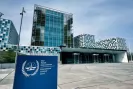
Russia’s Prosecutor General’s Office has sent the Netherlands a request to detain and extradite nine representatives of the International Criminal Court who were convicted in absentia in Russia. Those named include ICC President Piotr Hofmanski and Prosecutor Karim Khan, the supervisory authority’s press service said.
The requests were sent to the Netherlands’ Ministry of Justice and Security, as well as to a number of other countries. The list includes ICC President P. Y. Hofmanski, First Vice-President C. L. K. Carranza, Prosecutor K. K. A. Khan, and judges T. Akane, R. S. Aitala, S. H. U. Godines, B. Schmitt, R. A. S. Alapini-Gansou and H. B. Mahfoud. All nine have been placed on an international wanted list.
In December 2025, the Moscow City Court convicted all nine ICC representatives in absentia under Part 2 of Article 299 of the Russian Criminal Code, concerning bringing a person known to be innocent to criminal responsibility or unlawfully initiating a criminal case. They were also convicted under Part 2 of Article 301, concerning unlawful detention, arrest or custody, and Part 2 of Article 360, concerning attacks on people or institutions enjoying international protection or threats of such attacks.
The prison sentences range from three and a half to 15 years.
The Prosecutor General’s Office recalled that in November 2016 the Russian president issued an order declaring Russia’s intention not to become a party to the Rome Statute of the International Criminal Court. Notification of that intention was sent to the UN secretary-general. Russia has never been, and is not, a party to the statute and does not recognize the court’s jurisdiction.
The statement said that despite this, ICC Prosecutor Karim Khan had unlawfully brought charges against Russian citizens in The Hague. The Prosecutor General’s Office said the court’s presidency, without legal grounds, had instructed judges to issue manifestly unlawful arrest warrants. It argued that the decisions violated fundamental principles and norms of international law and were made without evidence that the individuals had committed the alleged crimes.
Source: tass.com
|

 4526 | 8 Oct. 2026 | 14:51














 Mobile verison
 RSS
RSS
