
 16929 | 23 Feb. 2026 | 10:39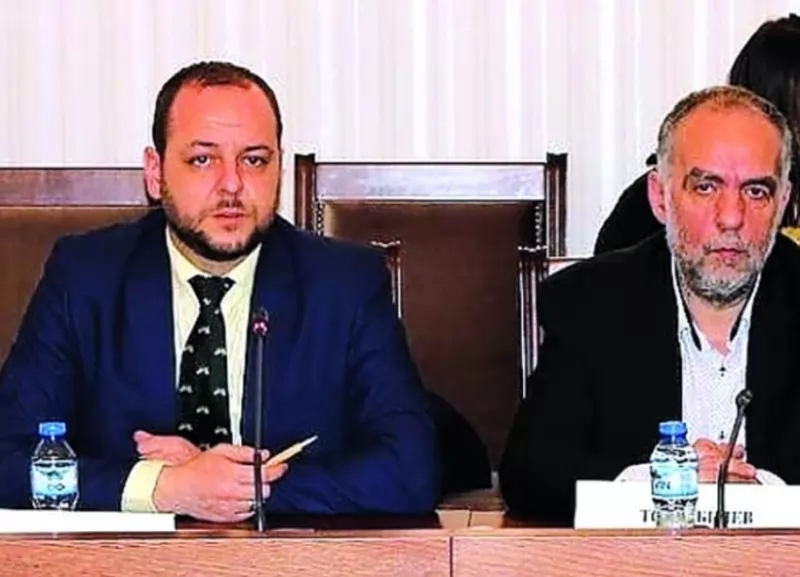
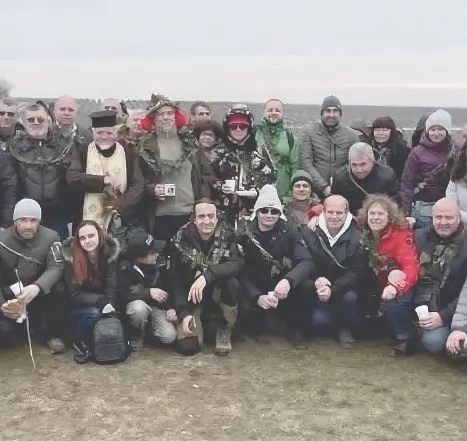


It turns out that back in 2022, during the mandate of the Kiril Petkov cabinet, in which Borislav Sandov was the Deputy Prime Minister for Climate and Minister of Environment, changes to the Protected Areas Act were discussed in the group of the CC-DB in the National Assembly, writes "Trud".
They were supposed to give private non-governmental organizations (NGOs) the opportunity to manage and protect the areas under Natura 2000. This encompasses 35% or 40,000 square kilometers of the country's territory.
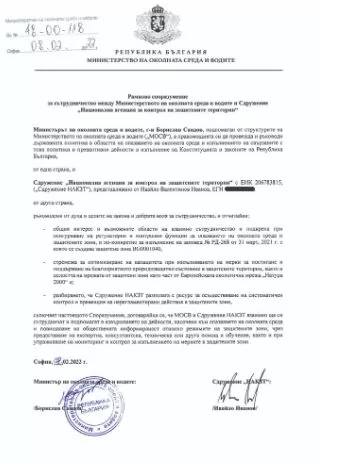
This is also a result and an extension of the framework agreement signed by Borislav Sandov with the National Agency for Control of Protected Areas under Ivailo Kalushev. Not only did Sandov and the CC-DB not want to annul the agreement, but on the contrary, they wanted to expand it and dress it in a legal form for control over a huge part of the country's territory.
"Natura zones must have management plans.
The development of one plan costs at least 1 million euros. This means that 360 million euros will go towards just the plans. Additional funds are also needed for protection. This means that the planned scheme by the Green Party and their coalition partner CC-DB amounts to approximately 1 billion euros.
The subject of the changes should have been Article 46 of the Protected Areas Act. It determines that the management and control of protected areas is carried out by the Ministry of Environment and Waters and its subdivisions. However, this specific text from the Protected Areas Act has been violated by Borislav Sandov, who has submitted to the National Agency for Protected Areas Control that Ivaylo Kalushev control and protect the Natura zone "Western Balkan Mountains" with a surface of 255,000 hectares."
The only downfall of Kiril Petkov's government prevented the adoption of these changes in the Protected Areas Act. According to Sandov himself, spoken years after the murder, the document did not create rights and obligations and was a "piece of paper" - a symbolic gesture of partnership for nature conservation.
In practice, however, this agreement turns out to be the key that legitimizes the activity of a private structure in the heart of protected areas of "Natura 2000". This combination - private ownership over a key object, paramilitary vision, serious equipment, international contacts and political legitimacy through a signed agreement with the state - turns the NGO into a structure that has existed for years in the gray area between civil initiative and private security formation.
And when this model ends with three bodies in the mountains, the question is no longer just who has shot, but who has allowed all of this to exist for so long under the guise of a "cause".
"Ecologists" have collected 56 million leva to count birds, fish, wild goats and bears.
Complete symbiosis between the party of ecologists "Green Movement" and their personal non-governmental organizations (NGOs). In addition, these NGOs own dozens of commercial companies through which the Greens create consortia and win public contracts. This is a closed system, where money stays within a close circle of friendly-political ties.
This scheme was created by ecologists Toma Belev, Borislav Sandov, Andrey Kovachev, Petko Kovachev, Petko Tsvetkov and many others. All of them have been chairmen or co-chairmen of the party "Green Movement". At the same time, they are active participants in civil NGOs.
These non-governmental organizations receive funding and secretly finance the party, using it to pressure institutions and acquire public contracts.
The fact that the scheme is working is proven by the fact that, taking advantage of their participation in the CC-DB Coalition, Borislav Sandov became Minister of Environment and Water and Toma Belev became Deputy Minister, both managing billions of lev for ecology in MOSV.
Non-governmental environmental organizations (NGOs) - Green Balkans, Bulgarian Society for the Protection of Birds, Swiss WWF (World Wide Fund for Nature), Swiss-Bulgarian Foundation "Biodiversity", Association for Wildlife "Balkan", "Association of Parks in Bulgaria", and many others - have received over 56 million lev solely for activities related to bird counting and resettlement.
Here is a list of the funding received from green non-governmental organizations during the first program period, totaling over 56 million leva:
Green Balkans - Stara Zagora
650,000 leva - feeding of black vultures
1,100,000 leva - rearing of mountain grouse
420,000 leva - consultations for Ovcharitsa dam management
470,000 leva - rearing of pelicans
1,700,000 leva - planting of willow trees
3,000,000 leva - counting of large European vultures
3,000,000 leva - counting of falcons
Bulgarian Society for the Protection of Birds (BSPB)
4,000,000 leva - counting of hawks and eagles
4,000,000 leva - conservation of pelicans around Burgas (they died out) 5,500,000 leva - preparation of a plan for the protection of the red-breasted goose
5,500,000 leva - monitoring of Egyptian vultures
8,000,000 leva - conservation of imperial eagles from wires
4,000,000 leva - construction of nests for lesser spotted eagles
95,000 leva - conservation of vultures in the Rhodope Mountains
18,000 leva - summer nature lectures
90,000 leva - school lectures
Green Balkans - Plovdiv
780,000 leva - construction of nests with mussels in Pomorie Lake 700,000 leva - counting of herons in the Maritsa River
200,000 leva - consultations for the management of Konush dam
WWF (World Wide Fund for Nature)
Veselina Kavrakova (Wife of Toma Belev)
Lyubomir Kostadinov, Alexander Dutsov, Konstantin Ivanov
700,000 leva - conservation of marshes and juniper around the Maritsa River
1,400,000 leva - counting of pelicans and consultations for their conservation in Srebarna reserve (they later died out)
800,000 leva - assistance to fish in the Rusenski Lom River basin
Nature Biodiversity Foundation
Petko Tsvetkov (Member of the National Council of the Green Party)
Stefan Avramov
4,000,000 leva - counting birds at Atanasovsko Lake
800,000 leva - aid for fish in Rusenski Lom
50,000 leva - summer environmental academy
50,000 leva - publishing environmental books
580,000 leva - monitoring wild goats and bears in Vitosha
450,000 leva - counting three-toed woodpeckers, capercaillie, and white-backed woodpeckers
Balkani Partnership for Development
Andrey Ralev (Treasurer of the Green Party)
Andrey Kovachev (Former Co-chair of the Green Party)
Katerina Rakovska (Wife of Andrey Kovachev, Advisor at the Ministry of Environment and Water)
580,000 leva - counting wild goats and bears
1,000,000 leva - hatching turtle eggs in the Aldomirovsko Marsh
2,000,000 leva - monitoring wild goats, insemination of the Apollo butterfly, and research on peaceful shrubs for wild bears
Project Partner: National Museum of Natural History at the Bulgarian Academy of Sciences (BAS)
Deputy Director of the Museum: Stoyan Beshkov (Member of the National Council of the Green Party)
Information and Nature Conservation Foundation
600,000 leva - training herbalists not to pick too many herbs because they might run out
In addition to the above-mentioned projects, there is data on smaller contracts worth 1-2 million leva, which brings the total amount to an additional 20 million leva.
This reference covers the period from 2007 to 2016. How much funds have been utilized since then will become clear after data is received under the Access to Public Information Act.
An interesting and highly suspicious fact is that the links to the contracts were active while Borislav Sandov became Minister and Toma Belev became Deputy Minister of Ecology. After that, the information was deleted.
How did Toma Belev appropriate the NGO with the misleading name Association of Parks in Bulgaria?
Toma Belev, connected to the signed illegal agreement between the Ministry of Environment and Water and the "National Agency for Control of Protected Territories" of Ivaylo Kalushev, has extensive experience in registering NGOs with misleading names, such as the "Association of Parks in Bulgaria".
The year is 2003. Eight state directorates of Nature Parks register the non-governmental organization (NGO) "Association of Parks in Bulgaria" (APB) without the consent of the Ministry of Agriculture and Forestry. This is a structure duplicating the core activity of the state park administrations, operating for private interest. The initiator of the creation of APB was the then director of Vitosha Nature Park, Toma Belev, later deputy minister of ecology. At the founding of APB, he was elected as its chairman.
Who were the founders
Seventeen years ago, in January 2003, acting as representatives of legal entities, the directors of eight of the 11 state nature parks founded APB. The association's stated purpose is the protection of protected territories - which is actually the main job of the park administrations themselves.
But besides nature conservation, the Association's registration includes economic activities in protected territories related to tourism and agriculture, marketing, revenue generation, and applying for international projects. Also - advertising policy, development of strategies and products. APB has the right to conduct consulting activities and participate in tenders.
From what has been listed so far, it is evident that APB's work almost 100% overlaps with the functions of the state park directorates. And Toma Belev was elected chairman because at that time he represented the Directorate of Vitosha Nature Park.
The Appropriation
Under the Non-profit Legal Entities Act and the APB Statute, the association is obliged every 5 years to hold a General Assembly to elect a new Management Board and chairman. This was not done in 2008, nor in 2013.
Meanwhile, in 2012, Belev was dismissed from his post as director of Vitosha Nature Park following a competitive selection process. This automatically meant he no longer had the right to represent APB, because until then he had been its chairman precisely in his capacity as director. And the failure to hold a General Assembly of the association means that after 2008, Toma Belev managed the structure illegally.
In 2014, Belev organized a General Assembly where he amended the association's Statute. This allowed him to bring 15 individuals - all his close associates - onto the APB Management Board. The goal was to gain a majority and be re-elected as chairman. That is exactly what happened. Thus, without any connection to the directorate of any nature park, Belev privatized the organization.
It was precisely this scheme and this General Assembly that were invalidated by panels of the Sofia City Court and the Sofia Appellate Court in December 2017, following a complaint from one of the nature parks that participated in the Association's creation.
Why does Belev need the APB?
The reason for this persistence is mundane - it's about money. From the very first years, when the association was managed by the directors of the state parks, it began acquiring properties. According to the Property Register, APB has acquired hundreds of decares of land in the districts of Ruse, Veliko Tarnovo, Razgrad, and Sliven. The properties are pastures, meadows, private agricultural lands. The reference from the Registry Agency for the Association of Parks' file is over 20 pages long.
But the "ecologist's" business ventures are not limited to the activities of APB and heading Vitosha Nature Park. From 2000 to 2014, he was on the Management Board of another private "nature conservation" organization - "Green Balkans", which deals with absorbing huge funds through projects and has purchased over 1000 decares of coastal land in Primorska Dobrudzha.
That is, at the same time, Belev worked in state service (director of Vitosha Nature Park) and in two private NGOs. Simultaneously, as an individual, he participated in many projects. An example is his collaboration in developing the Management Plan for Pirin National Park, Bulgarka Nature Park, and many others. These facts are clear evidence of a conflict of interest.
The Millions from Switzerland
Another reason Belev does not let go of the chairmanship of APB is the fact that the association participates in the project "Linking Nature Conservation with Sustainable Development of Rural Areas", financed with 4,790,000 Swiss francs or 8 million leva under the Bulgarian-Swiss Cooperation Programme. The project implementation began in 2012 and lasted four years.
A huge portion of the 8 million leva was spent on conferences, events, lectures, including with the participation of judges and prosecutors. Significant sums also went to a circle of affiliated media. The lectures were conducted by journalists from national radios and televisions. All of this had one goal - buying influence.
As for the actual contribution of the Bulgarian-Swiss Programme to the development of rural areas in Bulgaria, it is more than modest. Out of the 8 million leva resource, real businesses received 20,000 leva for a dairy in the Vratsa region, and a small workshop in the Northwest received similar funds for processing forest fruits and mushrooms. And that is all from 4,790,000 Swiss francs.









 Mobile verison
 RSS
RSS
